
Choosing between brackets and wires used to be simple. Today, you have options, and the right fit depends on your lifestyle and your smile goals. At Rittenhouse Orthodontics, we help families weigh Metal vs. Clear Braces every day, and this guide walks you through everything you need to know before your free consult.
Teens often love colorful elastics, while adults may prefer something more subtle for client meetings. The good news? Both options can deliver beautiful, lasting smile results. Here’s how they compare side by side, so you can walk into your free consult with real confidence about what you want.

What Are Metal and Clear Braces?
Metal braces use stainless steel brackets bonded to each tooth and connected by a thin archwire. Clear braces work the same way, but the brackets are made of tooth-colored ceramic that blends with your enamel. Both move teeth using steady, controlled pressure guided by a board-certified orthodontist.
Quick note on terminology: clear braces are not the same as Invisalign. Invisalign uses removable aligner trays with no brackets or wires. Clear braces are fixed to your teeth, just with a more discreet appearance than their metal counterparts.
We offer both options at Rittenhouse Orthodontics, and each is a proven, predictable way to correct crowding, spacing, and bite issues. Dr. Jordyn Middleberg, who is board-certified by the American Board of Orthodontics, will walk through which option best matches your smile goals during your visit. She takes time to answer every question so your family feels fully informed before any decision is made.
How Metal and Clear Braces Work
The process is nearly identical whether you choose metal or clear brackets. Here’s what to expect from start to finish:
- Free consult and digital scans. Your first visit at our Philadelphia office starts with photos, digital X-rays, and digital scans to map every tooth. No goo, no guesses.
- Treatment planning. Dr. Middleberg reviews your scans and builds a custom plan that outlines how your teeth will shift and roughly how long it will take.
- Bonding day. Each bracket is carefully placed on the front of your tooth using a dental-grade adhesive. An archwire is then threaded through the brackets and held in place with small elastic ties (or metal ligatures).
- Adjustment visits. You’ll come in every 4 to 8 weeks so we can change your wires, swap elastics, and track progress. These visits are quick, usually 20 to 30 minutes.
- Treatment length. Most families finish in 12 to 24 months, depending on how much movement is needed.
- Retainers. Once your brackets come off, you’ll wear a retainer to lock in your new smile for the long haul.
The mechanics behind both braces types are the same. The archwire holds your target tooth position, and the gentle tension slowly guides each tooth home.
Benefits of Metal vs. Clear Braces
Each option has real strengths. The best choice depends on what matters most to you.
Why families choose metal braces
- Highly durable. Stainless steel brackets handle daily life well, which is a big plus for active kids and teens.
- Efficient for complex cases. When significant crowding or bite correction is needed, metal often moves teeth with excellent control.
- Fun with colors. Elastic ties come in every color you can imagine. Eagles green and Phillies red are perennial favorites at our Philadelphia office.
- No staining concerns. Metal brackets don’t discolor, so coffee, tea, and tomato sauce aren’t a worry.
Why adults and teens choose clear braces
- Discreet appearance. Ceramic brackets blend with your natural tooth color, which makes them a popular pick for Philadelphia professionals in client-facing roles.
- Camera-friendly. On video calls or in wedding photos, clear braces stay subtle and let your smile take center stage.
- Great for older teens. High schoolers and college students at Penn, Drexel, or Temple often love the lower-profile look.
- Same results as metal. Clear brackets correct the same alignment and bite issues their metal counterparts do.
Each option gives you something a mail-order aligner kit can’t: orthodontist-controlled, in-person adjustments at every stage. That means your smile moves safely and your bite ends up right.
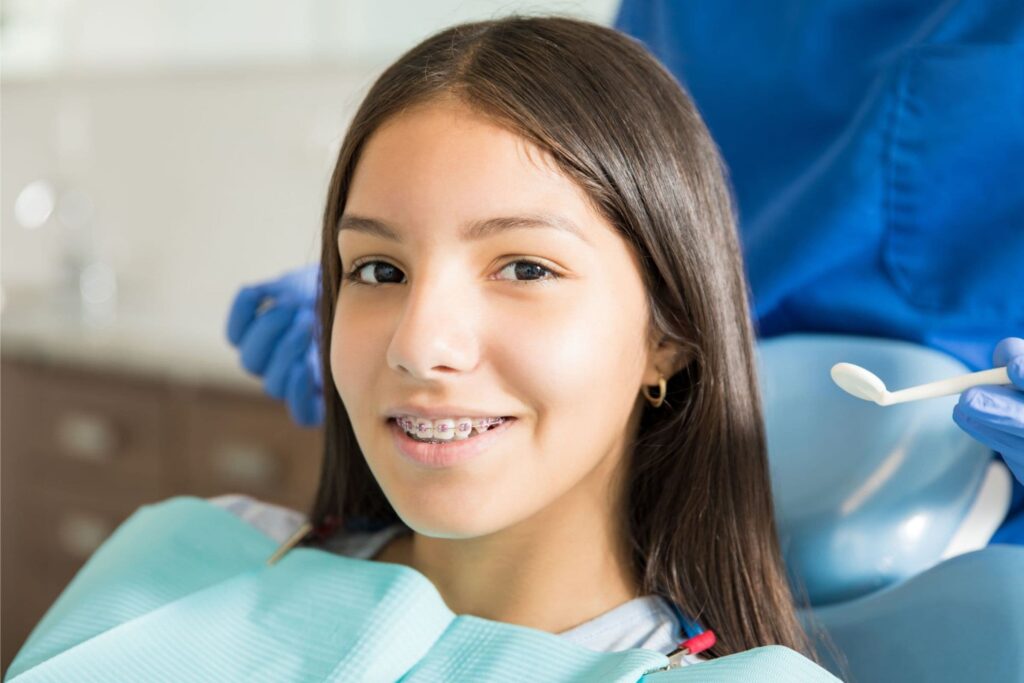
Metal vs. Clear Braces: Side-by-Side Comparison
Here’s how the two stack up at a glance:
| Feature | Metal Braces | Clear Braces |
|---|---|---|
| Appearance | Visible silver brackets | Tooth-colored, subtle |
| Treatment time | 12–24 months | 12–24 months |
| Durability | Very high | High (ceramic can be more brittle) |
| Comfort | Smooth modern brackets | Smooth, similar feel |
| Maintenance | Standard brush and floss routine | Standard routine, extra care with staining foods |
| Stain risk | None on brackets | Elastic ties can stain with coffee, tea, red wine, curry |
| Best for | Complex cases, kids, teens who love color | Adults, teens wanting a discreet look |
Most families see similar treatment time between the two. Very complex cases sometimes finish a bit faster with metal because of its strength under heavier wire forces. Each option delivers equivalent results for the majority of alignment and bite corrections.
One tip: if you choose clear braces, we swap your elastic ties at every adjustment visit, so any surface staining on the ties goes away. The ceramic brackets themselves don’t stain.
Who Is a Good Candidate for Each Option?
Both metal and clear braces work for kids, teens, and adults. The best choice comes down to your case and your lifestyle.
Metal braces may be the better fit if you:
- Have significant crowding, rotation, or a complex bite issue
- Are a younger patient who enjoys picking elastic colors
- Want the most durable fixed option
- Play contact sports or lead a very active lifestyle
Clear braces may be the better fit if you:
- Are an adult or older teen who prefers a subtle look
- Work in a client-facing role or are frequently on camera
- Have moderate alignment or spacing concerns
- Can commit to limiting staining foods or brushing promptly after them
Dr. Middleberg evaluates every smile individually. Her training as a board-certified orthodontist means she’ll recommend the option that moves your teeth safely, efficiently, and with the smile results you want. For families in Philadelphia, Rittenhouse, and East Falls, that personalized guidance is what makes a real difference between a good outcome and a great one.
Frequently Asked Questions
Is it better to get clear or metal braces?
Neither is universally better. Metal braces are stronger and often more efficient for complex cases. Clear braces offer a more discreet look that many adults and older teens prefer. The right answer depends on your case complexity and lifestyle, which Dr. Middleberg can review with you at your free consult.
What is the prettiest braces color?
That’s a fun one. Clear braces look the most natural because the brackets blend with your enamel. For metal braces, popular picks include silver (for a classic look), light blue or lavender (which make teeth look whiter), and seasonal colors like Eagles green or holiday red and green. Kids and teens love swapping colors at every visit.
Do clear braces stain?
The ceramic brackets themselves don’t stain. The small elastic ties that hold the wire can pick up color from coffee, tea, red wine, or curry, but we replace them at every adjustment visit, so any discoloration is temporary. Brushing soon after staining foods helps keep your smile looking bright between visits.
Are clear braces a good choice for teens?
Yes, especially for older teens who want a lower-profile look for school, sports photos, or college. Clear braces correct the same alignment and bite issues as metal braces. Younger or very active patients sometimes do better with metal for durability, and Dr. Middleberg will help your family weigh both.
Which type of braces is faster?
For most patients, metal and clear braces take about the same amount of time, typically 12 to 24 months. Very complex cases sometimes finish a bit faster with metal because it handles heavier wire forces well. Your timeline depends mostly on how much your teeth need to move.
How long does braces treatment take in Philadelphia?
Most families finish treatment in 12 to 24 months. Mild cases can wrap up sooner, and more involved bite correction may take a bit longer. Your treatment length depends on how far your teeth need to move and how closely you follow care instructions between visits.

Ready to See Which Option Fits Your Smile?
The best way to choose between metal and clear braces is to see your smile mapped out in 3D and talk through your goals with a board-certified orthodontist. At Rittenhouse Orthodontics, we offer free consults at both our Rittenhouse office at 1518 Walnut Street, Suite 500, and our East Falls location in Philadelphia.
No referral needed. Just high-tech smiles for your whole family, with zero stress from the first visit to the last. Book your free consult and let’s start your smile story together.